

Families are traveling together across generations, and many have someone in their group who needs some type of accommodation, whether it’s a wheelchair ramp, an itinerary that’s easy to navigate with a walker, a gluten-free menu, or an autism-friendly kids’ camp. More than half of families (55%) planning a multigenerational trip say someone in their group needs some sort of accommodation. Most (78%) of those families say they would pay more to make sure those needs are properly met.
In July and August 2026, travel company Fora surveyed 1,359 Fora travel advisors (including 910 who have booked accessible travel) and a nationally representative sample of 2,592 consumers, asking about accessibility needs, spending, and experiences booking travel. The findings show demand is significant and growing. But the travel industry is still catching up.
Key takeaways
- A large majority (67%) of Fora advisors have booked a trip for a client with an accessibility need, and 18% of those say it's now more than a quarter of their business.
- According to the consumer survey, more than half (55%) of families planning a multigenerational trip in the next three years say someone in their travel group would have an accessibility need.
- Seventy-eight percent of families planning a multigenerational trip and requiring an accommodation would be willing to pay more to ensure the trip meets everyone's accessibility needs.
- Forty-four percent of Fora advisors say their largest accessible booking in the past year was $10,000 or more.
- Ninety percent of Fora advisors say online info about accessibility can be incomplete, outdated, or contradictory—and nearly half (46%) say it's often or always off base.
Accessible travel isn’t a niche
For many travel advisors, accessible travel is routine work. Two-thirds of Fora advisors surveyed (67%) have booked a trip for a client with an accessibility need. Of those advisors, 34% say these trips now make up more than 10% of all their bookings, and 18% say it's more than a quarter of their business.
What are those accessibility needs? The most common needs advisors plan for are limited walking endurance or stamina (75%), food allergies or dietary restrictions (68%), and mobility or wheelchair access (55%).
Multigenerational travel is accelerating the demand
Sixty-two percent of consumers have taken a multigenerational trip, with 30% taking one at least every few years. And more are on the way: 35% are planning or considering a multigenerational trip in the next three years, rising to 52% among households earning $150,000 or more a year.
Accessibility needs will be built into many of these trips. More than half (55%) of consumers planning a multigenerational trip in the next three years say someone in their group will need an accommodation.
Advisors are feeling the shift as well: Almost half (48%) say demand for multigenerational trips with accessibility needs has grown compared with last year. And multigenerational groups are the ones they're booking accessible trips for most often—67% of advisors have planned one, compared to 57% who have booked for a couple and 38% for parents with children.

Fora
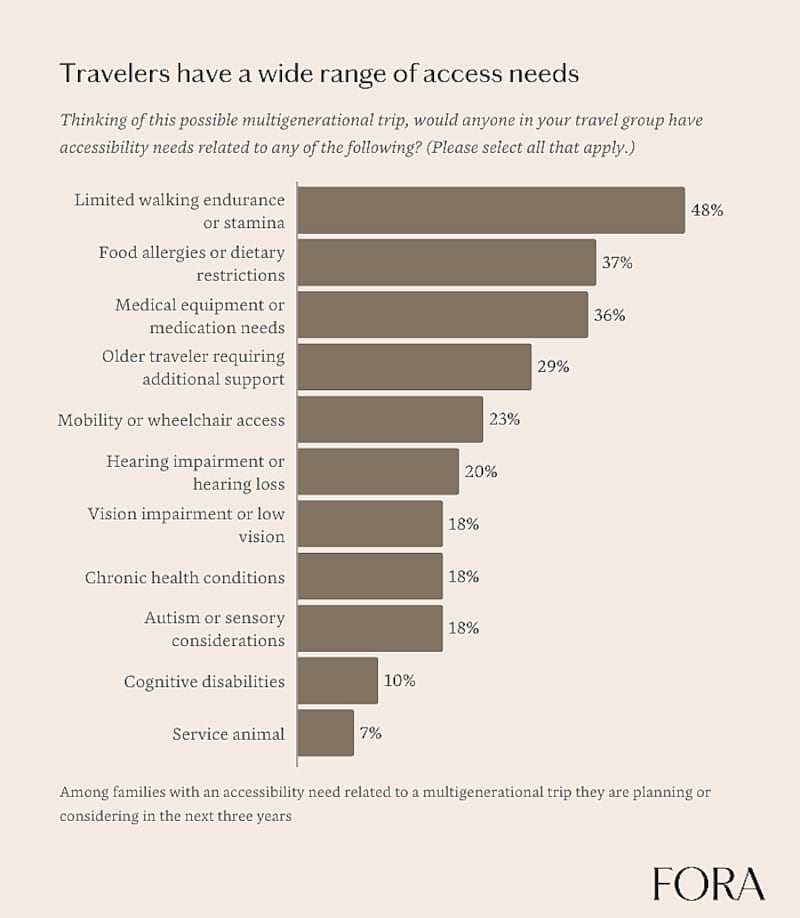
Consumers who say their families have accessibility needs for a multigenerational trip they’re planning or considering report a wide range of issues, with the most common being limited walking endurance or stamina (48%), food allergies or dietary needs (37%), or medical equipment or medication (36%). Among these, 68% have multiple accessibility needs in their group. Mobility or wheelchair access ranks fifth on this list, behind where advisors might expect it. Although wheelchair access may be less common than other needs, it demands more planning expertise when it does come up.
Fora
Seniors aren’t the only ones with needs
As one might expect, older travelers often show up in accessible trips. But they don’t dominate them: 55% of advisors say less than half of their accessible bookings involve a traveler 65 or older.
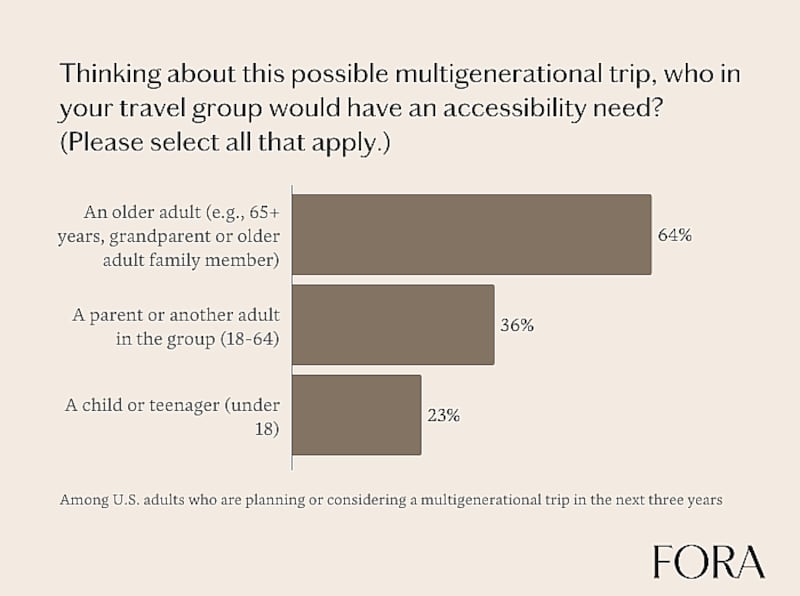
Consumers say that family members of all ages need accommodations. Adults 65 or older have accessibility needs among the majority (64%) of those respondents saying they need accommodations for a potential trip. More than one in three (36%) say a parent or another adult (age 18 to 64) in their group would need an accommodation, and almost one in four (23%) say a child or teenager would. These needs span multiple generations: 20% of these families would have more than one generation with a need in their group.
Fora
Travelers are willing to pay more to have accessibility needs met
U.S. travelers with disabilities spend nearly $50 billion a year on travel, and more than $100 billion once their companions are included, according to a 2024 Open Doors Organization and Harris Poll study. The data shows that not only are these travelers willing to spend, they're willing to spend more.
More than four in 10 (42%) of those who have taken or are planning or considering a multigenerational trip say they’d be willing to pay more per person for a multigenerational trip compared to a typical vacation. Add someone who needs an accommodation, and the figure jumps: Among those planning or considering a multigenerational trip (for which they will need at least one accommodation) within the next three years, 78% would pay more for a trip that properly meets everyone’s needs.
Peace of mind has a price
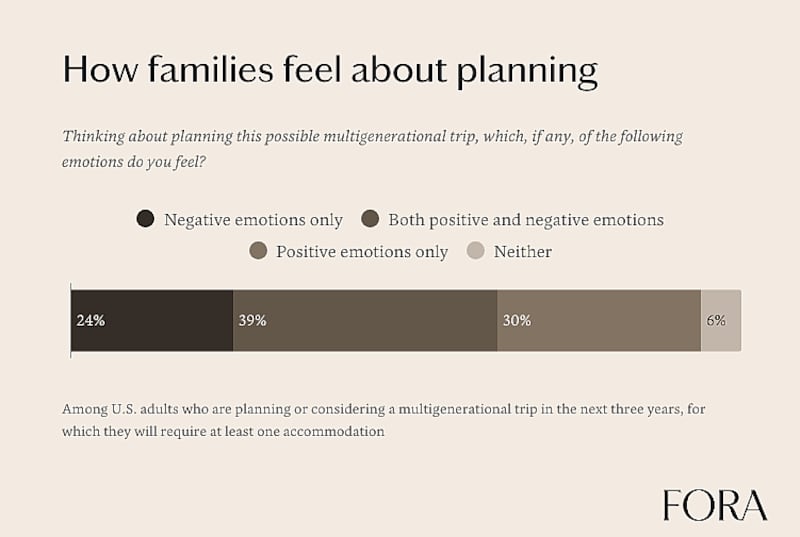
Sixty percent of consumers planning or considering a multigenerational trip and requiring an accommodation say they feel excited about creating shared memories. But almost a third (31%) feel stressed about whether a hotel or other lodging will actually meet their group’s needs, and nearly as many (29%) are anxious about finding accurate information beforehand.

Fora
These feelings aren’t mutually exclusive. Seven in 10 report at least one positive emotion, more than six in ten (63%) report at least one negative one, and many feel both.
Fora
‘Accessible’ doesn’t mean ‘budget’
Advisors frequently book high-value accessible trips: 52% have booked a cruise for a client with accessibility needs, and 48% have booked a luxury hotel for a client with accessibility needs. No matter what the accommodation, these are not low-cost trips: 44% say their largest accessible booking in the last 12 months topped $10,000—several times the average booking value. And 78% say accessible trips generate the same or higher spend than the average trip.

Fora
Booking these trips drives loyalty. Fifty-five percent of advisors say clients with accessibility needs are more likely than their average clients to become repeat clients.
Travelers also find working with an advisor helpful for these high-touch trips. Among consumers with an accessibility need in their group for an upcoming trip who have previously worked with a travel advisor on an accessible trip, 90% say they’d use that advisor again, nearly matching the 93% for multigenerational trips and well above the 68% for other kinds of trips.

Fora
Accessibility details are challenging to find
Eighty-six percent of travelers say it would be important to them to confirm details about accessibility before booking lodging or activities. But that can be difficult, if not impossible—even for the experts. Ninety percent of Fora advisors say online info about accessibility can be incomplete, outdated, or contradictory—and almost half (46%) say it’s often or always off base.
Advisors call ahead, confirm details in writing, and double-check their research—it’s the job. And still, almost a third (31%) have had a client show up at a property to find a promised accessibility feature missing or unusable.
Details can be elusive even for basics
Some topics are harder to research than others. Excursions and activities top the list: 47% of advisors call it one of the hardest topics to find clear, trustworthy information on (and 48% say it’s a part of the trip suppliers are least prepared to support). But nearly as difficult to research are travel fundamentals like hotel room and bathroom details (44%) and on-property access (41%)—crucial for determining whether a room and property can work for a traveler.

Fora
A bigger budget doesn’t make an accessible room easier to find. Among advisors who work with luxury clients, 41% say it’s difficult to source luxury options that also meet accessibility needs.
The problem doesn’t ease with experience. Among advisors whose accessibility bookings make up 10% or less of their business, 43% say it’s difficult to find accommodations that truly meet a client’s needs. Among advisors for whom those bookings make up more than half their business, that number jumps to 73%. That suggests the problem isn’t training, but rather the infrastructure and information advisors have to work with.
Signs of progress
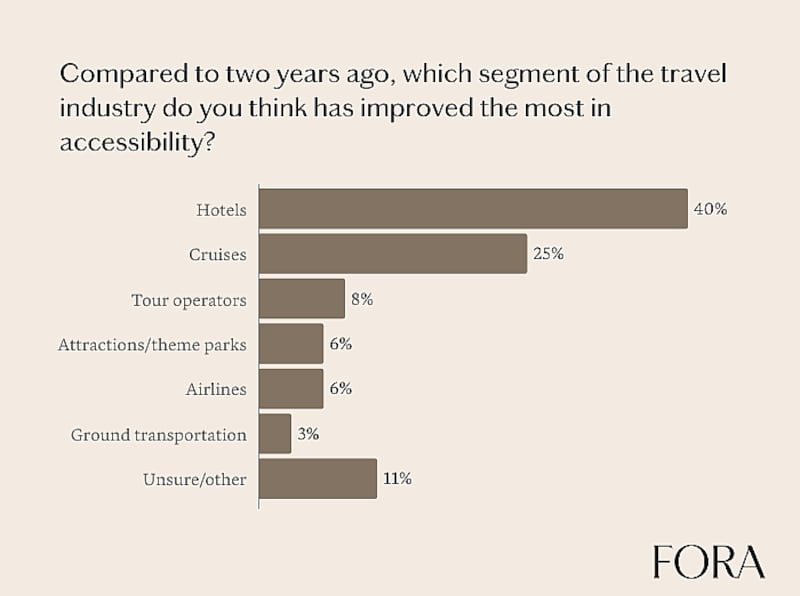
Nearly half of advisors (47%) say the industry’s accessibility efforts have improved over the past two years. Hotels get the most credit: 40% of advisors name hotels as the segment that’s improved the most, followed by cruise lines at 25%.
Fora
Although hotels get credit for most-improved, cruise gets the most love: When advisors were asked, “What is your favorite hotel, resort, cruise line, or experience to recommend when accessibility really matters?” 40% of those who answered named a specific cruise line, vs. 31% who named a specific hotel or resort brand.
Among advisors who say accessible travel is more than 10% of their business, Royal Caribbean Group brands took the top spots among cruise, with Royal Caribbean (26% of cruise mentions) praised for wheelchair- and mobility-accessibility, service-animal handling, and autism/sensory accommodations; sister brand Celebrity Cruises (21%) came in second. Norwegian Cruise Line (14% of cruise mentions) and Viking (12% of cruise mentions) were third and fourth, with Disney Cruise Line (9%) rounding out the top five.
Disney led the pack in hotel/resort recommendations, with 40% of those mentioning a specific brand recommending Disney. Hilton (14%), Marriott (12%), and Hyatt (7%) also earned kudos, while Sandals/Beaches (7%) was specifically called out for its handling of autism and sensory-specific needs.
What’s next?
Hotels and suppliers are already chasing multigenerational travel groups in their marketing and their product offerings. As this report shows, most of these travelers will have someone with accessibility needs in their group—and they’re willing to pay to have those needs met.
Methodology
Consumer data
Fora commissioned YouGov to poll 2,592 Americans 18 or older. The survey was carried out online from July 24 through July 28, 2026. The results have been weighted to be representative of all U.S. adults.
Advisor data
Fora surveyed 1,359 Fora advisors at the Certified level or above (Certified, Advanced, Pro, and Fora X). Respondents below Certified were excluded from all results in this report. The survey ran online from August 5 through August 17, 2026.
Except for the finding that 67% of advisors have booked a trip for a client with an accessibility need, every other advisor statistic in this report is based only on the 910 of those advisors who have booked a trip for a client with an accessibility need, not the full 1,359 surveyed.
All percentages have been rounded to the nearest whole percent. Totals may not equal 100%.
This story was produced by Fora and reviewed and distributed by Stacker.